What is Esna Temple?

Esna Temple is a beautifully preserved yet often overlooked monument located about 55 km south of Luxor. Dedicated to the god Khnum, it features detailed reliefs, vivid ceiling decorations, and well-preserved hieroglyphs from the Greco-Roman period.
Unlike larger, crowded temples, Esna offers a quieter and more intimate experience. Its main highlight—the hypostyle hall—lies about nine meters below modern street level, creating a unique sense of stepping back in time. With its manageable size and remarkable preservation, the temple provides a meaningful and immersive glimpse into ancient Egyptian religious architecture.
What is Esna Temple?
Esna Temple, also known as the Temple of Khnum, is a Greco-Roman period temple dedicated primarily to Khnum, the ram-headed god who ancient Egyptians believed created humanity on his potter's wheel.
Built during the Ptolemaic and Roman periods (approximately 40-250 CE), the temple represents the final phase of ancient Egyptian temple construction—a time when Greek and Roman rulers of Egypt maintained and honored traditional Egyptian religious practices and architectural forms.
Location and Context
The temple sits in modern Esna town center (ancient Latopolis), positioned on the Nile's west bank roughly halfway between Luxor and Aswan. Most Nile cruise ships sailing between these cities stop at Esna Lock—making the temple convenient for cruise passengers to visit during the wait for lock passage. Independent travelers can easily reach Esna Temple from Luxor by car, taxi, or microbus, making it an excellent half-day excursion from Luxor accommodations.
Current State
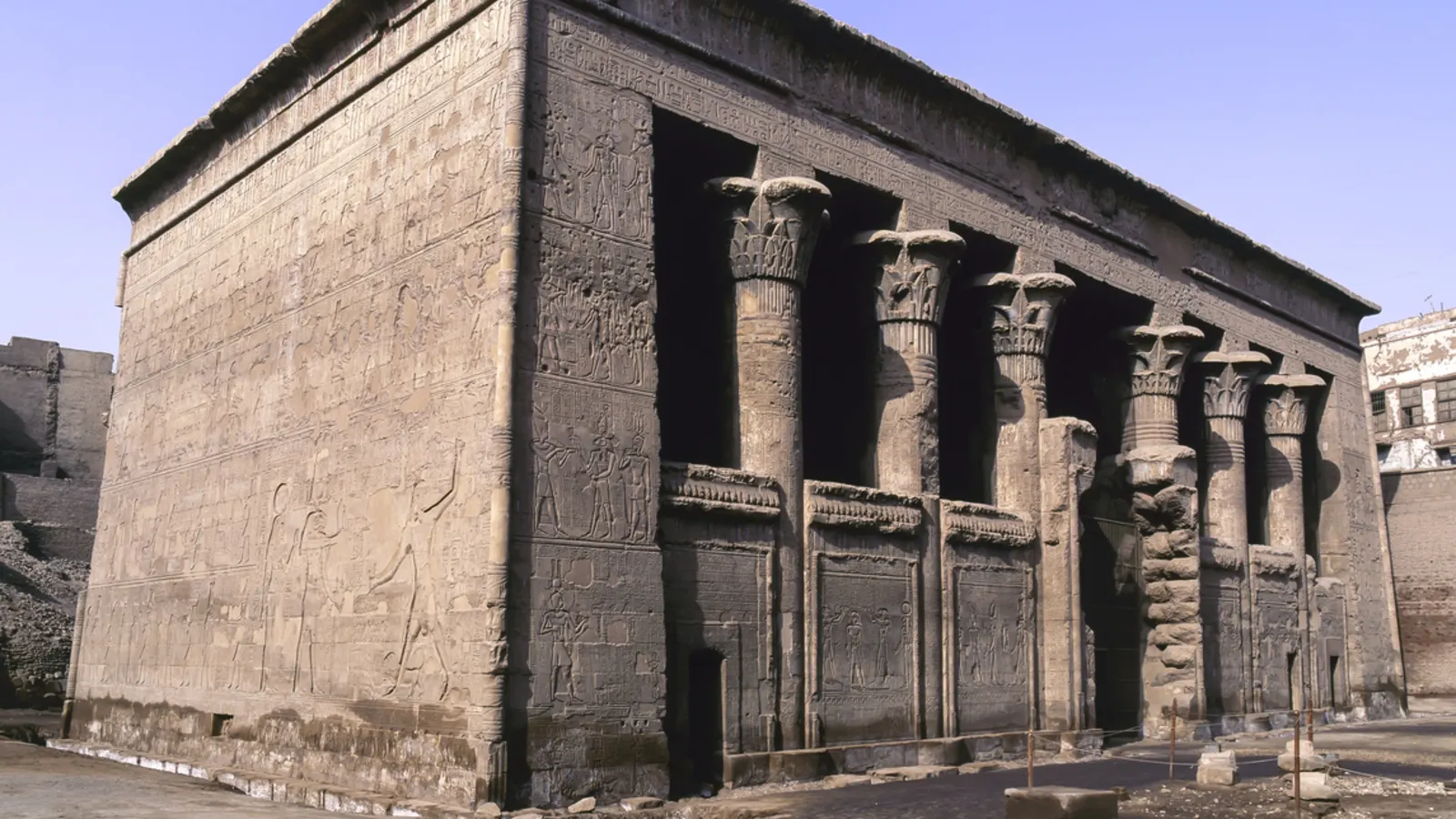
What visitors see today is the temple's hypostyle hall—a columned chamber that formed the entrance section of what was once a much larger complex. The rest of the temple (inner sanctuaries, courtyards, pylons) remains unexcavated, buried beneath modern Esna's buildings and streets.
Archaeological evidence suggests the complete temple was substantial, but urban development over centuries makes full excavation unlikely.
Despite only the hypostyle hall being accessible, what remains is extraordinary. The 24 massive columns with elaborate capitals, ceiling covered in astronomical and religious scenes, and walls filled with detailed relief carvings and hieroglyphs create an immersive ancient experience few Egyptian temples can match.
What to See at Esna Temple

History of Esna Temple
Ancient Esna: City of the Ram God
Esna's history extends far beyond the current temple structure. The town served as an important religious and administrative center in ancient Egypt, particularly associated with worship of Khnum, the creator god who shaped humans and their ka (life force) on his potter's wheel. Egyptians also worshipped Khnum as controller of the Nile's annual flood—the inundation that made Egyptian agriculture and civilization possible.
Earlier temples certainly existed on this site dating to pharaonic periods, but the structure visible today was built entirely during Greco-Roman rule of Egypt—a period from approximately 332 BCE (Alexander the Great's conquest) through the Roman Empire's control until Christianity became dominant around 400 CE.
Construction Timeline
Construction of the current Esna Temple hypostyle hall began during the reign of Ptolemy VI (180-145 BCE) and continued intermittently for nearly 400 years, with Roman emperors adding decorations and inscriptions through at least 250 CE.
This extended construction period explains the temple's eclectic decorative program—incorporating traditional Egyptian religious iconography alongside Greco-Roman artistic influences and even references to Roman imperial cult.
Cartouches (name rings) of various Roman emperors appear throughout the temple, including Claudius, Vespasian, Titus, Domitian, Trajan, Hadrian, Antoninus Pius, Marcus Aurelius, Commodus, Septimius Severus, and others—creating a remarkable historical record of Roman Egypt spanning centuries.
Medieval and Modern Periods
After Christianity became Egypt's dominant religion in the 4th century CE, Esna Temple was abandoned as a pagan religious site. Over subsequent centuries, sand and debris accumulated, and the town of Esna literally built itself atop the ancient temple. By the medieval period, the hypostyle hall was completely buried, with buildings and streets covering it.
Excavation of the temple began in the mid-19th century when French archaeologist Auguste Mariette cleared the hypostyle hall, revealing its extraordinary state of preservation. The sand and debris that buried the temple also protected it from vandalism, weathering, and the damage that exposed monuments suffered—explaining why Esna Temple's reliefs and colors remain so vibrant.
Architecture and Design of Esna Temple
Architecture and Design of Esna Temple
The Hypostyle Hall
The accessible portion of Esna Temple consists of a rectangular hypostyle hall measuring approximately 37 meters long by 20 meters wide, supported by 24 massive columns arranged in six rows of four columns each. The hall served as the temple's entrance section where preliminary rituals occurred before priests proceeded to inner sanctuaries.
The Magnificent Columns
Esna Temple's 24 columns are architectural masterpieces, each standing approximately 13 meters tall and topped with elaborate composite capitals combining floral and geometric motifs. No two capitals are identical—each displays unique designs incorporating lotus flowers, papyrus plants, palm fronds, and decorative patterns.
The column shafts feature extensive hieroglyphic inscriptions and relief carvings depicting religious scenes, royal offerings, and divine interactions. The variety and quality of these carved decorations transform each column into an individual artistic statement while creating collective harmony throughout the space.
The Astronomical Ceiling
Esna Temple's ceiling ranks among the finest preserved astronomical ceilings in Egypt. Elaborately decorated with astronomical scenes, zodiac signs (introduced during Greco-Roman period), divine figures, and religious symbolism, the ceiling represents ancient Egyptian cosmology and their understanding of celestial cycles.
Traces of original paint remain visible in many ceiling sections, showing blues, reds, yellows, and greens that once covered the entire surface—helping visitors imagine the visual impact when temples gleamed with color rather than appearing as bare stone.
Key ceiling scenes include the sky goddess Nut stretched across the heavens, solar barques carrying deities across the sky, constellations, and the twelve zodiac signs incorporating Greek astronomical knowledge into Egyptian religious frameworks.
Wall Reliefs and Inscriptions
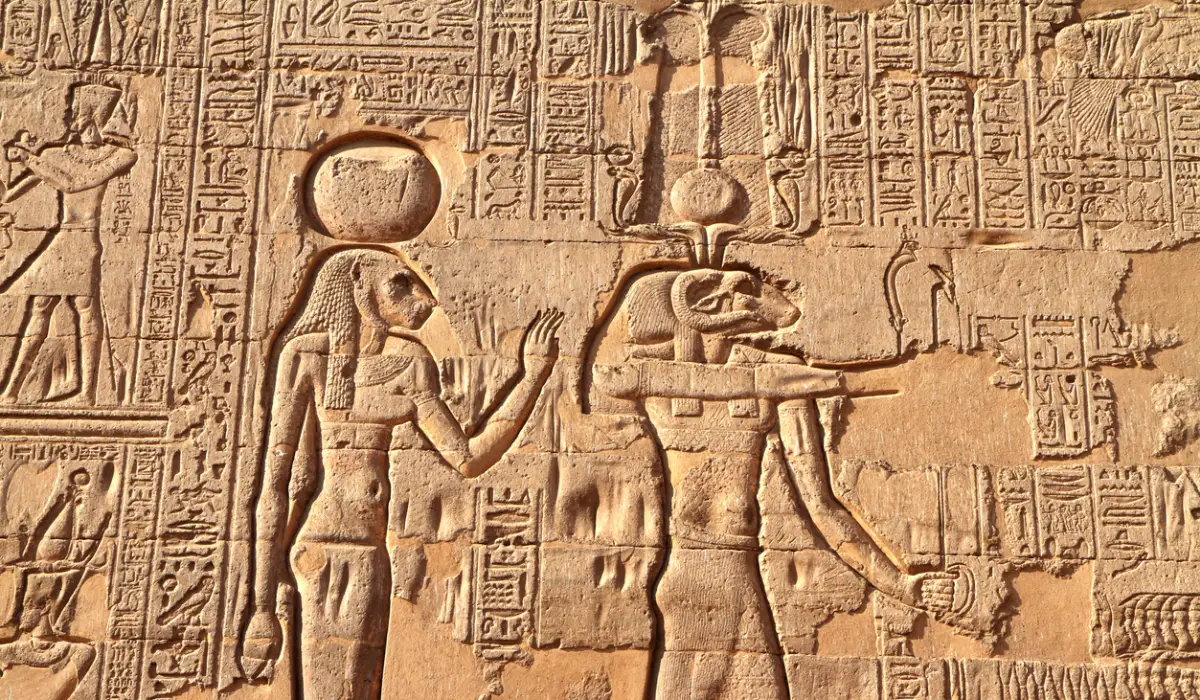
The walls of Esna Temple's hypostyle hall contain extensive relief carvings depicting traditional Egyptian religious scenes: pharaohs (actually Roman emperors styled as Egyptian pharaohs) making offerings to gods, divine processions, religious festivals, and interactions between deities.
Notable scenes include:
- Festival scenes showing religious processions and ceremonies honoring Khnum
- Creation myths depicting Khnum fashioning humans on his potter's wheel
- Hymns to Khnum inscribed in hieroglyphs praising the creator god
- Roman emperors shown in traditional Egyptian royal regalia performing rituals
- Crocodile worship references to Sobek, also honored at Esna
- Greco-Roman influences including zodiac signs and classical artistic elements
The hieroglyphic texts provide valuable information about temple rituals, religious beliefs, and historical events during the Greco-Roman period—making Esna Temple important not just aesthetically but as a historical document.
Religious Significance: Khnum and the Egyptian Pantheon

Religious Significance: Khnum and the Egyptian Pantheon
Khnum: The Creator God
Khnum, primary deity of Esna Temple, was one of Egypt's oldest gods, worshipped from predynastic times through the Roman period. Typically depicted as a man with a ram's head, Khnum was believed to create humans by shaping them from clay on his potter's wheel—making him a creator deity controlling human existence and destiny.
Khnum also controlled the Nile's annual inundation, making him crucial to Egyptian agricultural survival. Temple reliefs show Khnum releasing the flood waters that fertilized Egypt's fields, emphasizing his role as provider of life and sustenance.
Associated Deities
While Khnum was the principal god, Esna Temple honored several other deities:
- Neith: The ancient war and weaving goddess, particularly important in Esna
- Heka: God of magic and medicine
- Menhet and Nebtu: Khnum's consorts in various traditions
- Sobek: The crocodile god also worshipped at Esna
This multiplicity reflects Egyptian religious complexity where temples served as homes for multiple deities with interrelated roles in cosmic order.
Temple Festivals
Inscriptions at Esna Temple describe various religious festivals celebrated there, including the Festival of the Potter's Wheel where Khnum's creative power was honored, and festivals celebrating the Nile flood's arrival. These festivals involved processions, offerings, music, and communal celebrations integrating religion deeply into community life.
What to See at Esna Temple

What to See at Esna Temple
The Entrance Experience
Approaching Esna Temple means descending approximately nine meters below modern street level—a dramatic entry creating immediate separation from contemporary Egypt. The stone stairway leads down into the hypostyle hall where ancient atmosphere envelops you despite the modern town visible above the walls.
Column Capital Diversity
Take time examining individual column capitals—each displays unique floral compositions combining lotus, papyrus, and palm designs. The craftsmanship demonstrates Egyptian mastery of stone carving even in the Greco-Roman period when some argue Egyptian art was in decline.
Astronomical Ceiling Details
Look upward to study the ceiling's astronomical scenes. Identify zodiac signs like Taurus, Gemini, and Aquarius incorporated into Egyptian religious iconography. Notice how scenes are organized in registers (horizontal bands) depicting different aspects of cosmology and divine interaction.
The Khnum Hymns
On the west wall, extensive hieroglyphic texts praise Khnum in elaborate hymns describing his creative powers, his control of the Nile, and his importance to Egyptian well-being. These texts represent some of the latest hieroglyphic inscriptions created before the ancient Egyptian writing system disappeared.
Roman Emperor Cartouches
Throughout the temple, cartouches contain names of Roman emperors written in hieroglyphs—a fascinating cultural fusion showing Roman rulers adopting Egyptian royal titulary and presenting themselves as traditional pharaohs to maintain legitimacy with Egyptian subjects.
Relief Details and Original Color
Many reliefs retain traces of original paint—blues, reds, yellows, and greens visible in protected areas. These paint remnants help imagine how vibrantly colorful Egyptian temples originally appeared, challenging the bare stone appearance we typically encounter.
Visiting Esna Temple: Practical Information
Getting to Esna from Luxor
Esna sits approximately 55 kilometers (34 miles) south of Luxor, making it an easy half-day excursion. Travel options include:
Private car or taxi: The most convenient option, taking about 45-60 minutes each way. Negotiate prices in advance; expect 400-600 Egyptian pounds for round trip with waiting time.
Microbus: Budget option departing from Luxor; microbuses leave when full and cost 10-20 pounds per person. Less comfortable but authentic local experience.
Organized tour: Many Luxor hotels and tour operators offer Esna Temple excursions, often combined with other sites.
Nile cruise stop: Most Nile cruises between Luxor and Aswan pass through Esna Lock. Some cruise itineraries include temple visits during lock wait times, though this may be rushed.
Opening Hours and Entry Fees
Esna Temple opens daily from approximately 6:00 AM to 5:00 PM (hours vary seasonally). Entry fees for foreign tourists are typically 100 Egyptian pounds (subject to change). Student discounts available with valid international student cards.
Best Time to Visit
Early morning (6:00-8:00 AM): Coolest temperatures, softest light for photography, fewest tourists. Ideal for serious photography and peaceful contemplation.
Late afternoon (3:00-5:00 PM): Good light angles, cooler than midday, but potentially busier if Nile cruise groups visit.
Avoid midday (11:00 AM-2:00 PM): Intense heat, harsh overhead light, and potential crowd congestion from cruise groups.
Seasonal considerations: October-April offers comfortable temperatures. May-September brings extreme heat making exploration uncomfortable, though you'll encounter fewer tourists.
Combining Esna Temple with Other Sites
Day Trip from Luxor
Esna Temple works well in longer Luxor day trips. Consider combining with:
El-Kab: Ancient town ruins with rock-cut tombs, 20 km north of Esna
Edfu Temple: The best-preserved temple in Egypt, 60 km south of Esna
Kom Ombo Temple: Double temple to Sobek and Horus, further south
This creates a comprehensive ancient Egyptian experience spanning different periods and architectural styles.
Nile Cruise Integration
Most Luxor-Aswan Nile cruises pass through Esna Lock. While some itineraries include temple visits, many don't allow adequate time for proper exploration. Inquire about temple visit inclusion when booking cruises, or plan independent visits before or after your cruise.
FAQs

FAQs
Q1: Where is Esna Temple located in Egypt?
Esna Temple is located in Esna town (ancient Latopolis) on the Nile's west bank, approximately 55 kilometers (34 miles) south of Luxor and 60 kilometers north of Edfu. The temple sits below modern street level in Esna's town center, easily accessible from Luxor by car, taxi, or microbus in about 45-60 minutes.
Q2: What can I see at Esna Temple?
At Esna Temple, you'll see a beautifully preserved Greco-Roman hypostyle hall featuring 24 massive columns with elaborate capitals, an astronomical ceiling with original colors and zodiac signs, detailed wall reliefs showing Roman emperors as pharaohs making offerings to Khnum (the ram-headed creator god), extensive hieroglyphic inscriptions, and hymns to Khnum carved on walls.
Q3: How long does it take to visit Esna Temple?
A thorough visit to Esna Temple takes 45-90 minutes. The temple consists only of the hypostyle hall (the rest remains unexcavated), making it manageable compared to massive complexes like Karnak. Allow 45 minutes for basic exploration, 60-90 minutes for detailed examination of column capitals, ceiling scenes, and relief carvings, plus photography.
Q4: Is Esna Temple worth visiting from Luxor?
Yes, Esna Temple is worth visiting from Luxor, especially for travelers interested in Greco-Roman Egyptian architecture, well-preserved ancient art, or seeking uncrowded monuments. The temple offers exceptional ceiling preservation with original colors, unique column capitals, and intimate atmosphere impossible at Luxor's crowded sites. It works well as a half-day Luxor excursion.
Q5: What is the entrance fee for Esna Temple?
The entrance fee for Esna Temple is typically 100 Egyptian pounds for foreign tourists (approximately $3-4 USD, subject to change). Egyptian students with valid international student cards receive discounts. Photography is generally permitted. The ticket office is located at the temple entrance at the bottom of the stairs descending from street level.
Q6: Can I visit Esna Temple during a Nile cruise?
Yes, you can visit Esna Temple during Nile cruises between Luxor and Aswan. Most cruises pass through Esna Lock, and some itineraries include temple visits during the lock wait (usually 1-2 hours). However, not all cruises include the temple visit, so check your specific itinerary. Independent visits from Luxor offer more time for exploration.