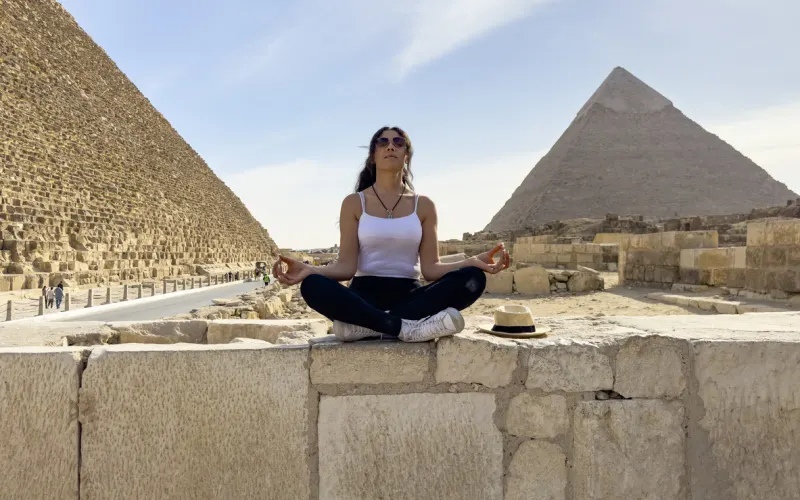

Cairo, known as "Mother of the World," is a majestic metropolis where ancient history and modern life coexist. As the largest city in the Middle East and Africa, it is a treasure trove for history enthusiasts, with iconic sites like the Pyramids and the Egyptian Museum. The city's multi-layered history, from Coptic churches to Islamic architecture, and its timeless markets like Khan el-Khalili, reveal a rich tapestry of civilizations.
Iconic Cairo: Pyramids and the Sphinx
The Great Pyramid of Giza commands respect as the last intact ancient Wonder of the World, an architectural achievement that defies the passage of millennia. These colossal monuments emerge from the desert sands with an authority that has drawn countless visitors across centuries, each seeking to witness firsthand the pinnacle of human ambition carved in stone. The Giza Plateau houses these extraordinary structures, constructed more than 4,500 years ago, representing humanity's earliest attempts to touch eternity through engineering prowess unmatched in the ancient world.
Why they're a must-see
The Pyramids of Giza, including the monumental tombs of pharaohs Khufu, Khafre, and Menkaure, were built as eternal resting places to safeguard their mummified remains. The Great Sphinx, a statue with a lion's body and human head, adds to the complex's historical significance. The sheer scale of these ancient structures, which were designed to ensure the pharaoh's successful journey to the afterlife, continues to captivate visitors.
Tips for visiting without a guide
Independent exploration of the pyramids rewards visitors with intimate encounters at their own rhythm. Self-guided visits eliminate the constraints of group schedules while allowing deeper personal connections with these ancient marvels.
Essential strategies for successful independent visits include:
- Arrive early - Entrance at opening time (around 8 am) ensures cooler temperatures and fewer crowds
- Stay in Giza the night before - Accommodation just 50 meters from the entrance guarantees first access
- Start with the Sphinx - Most visitors rush to the Great Pyramid, leaving the Sphinx area relatively peaceful for early arrivals
- Bring essentials - Water, sunscreen, protective headwear, and sturdy footwear prove indispensable for extensive walking across the complex
- Be prepared to say no - Vendors will approach with camel rides and souvenirs, but a courteous declination maintains your planned itinerary
Contrary to common assumptions, neither professional guides nor camel rides are mandatory for pyramid visits. A thorough walking exploration typically requires 4-5 hours when allowing adequate time for photography.
Hidden tombs and viewpoints nearby
Strategic vantage points around the Giza Plateau offer unique perspectives on the pyramids, including the classic alignments from Panoramic Point and "the Money Shot" favored by photographers. Visitors can also view all nine pyramids simultaneously from the southern dunes.
Recent archaeological discoveries continue to add to the site's mystique, with the identification of a mysterious L-shaped structure buried beneath the royal cemetery. Exploring the interior of the pyramids is a worthwhile experience, offering an unparalleled glimpse into these ancient wonders.

Cultural Cairo: Museums and History
The museums of Cairo serve as repositories of human achievement, where the weight of five millennia settles upon visitors with quiet authority. This city safeguards the largest collection of Pharaonic antiquities in the world, each artifact bearing witness to a civilization whose influence continues to shape our understanding of ancient societies. These institutions function not merely as exhibition halls, but as scholarly sanctuaries where Egypt's most precious cultural heritage finds proper stewardship and interpretation.
Egyptian Museum vs. Grand Egyptian Museum
The Egyptian Museum, a cornerstone of Egyptian archaeology since 1902, holds over 170,000 artifacts, including the Narmer Palette and the burials of Yuya and Thuya. This is complemented by the new Grand Egyptian Museum (GEM), a monumental, over $1 billion project near the Giza Pyramids. The GEM is set to become the world's largest archaeological museum dedicated to a single civilization, housing more than 50,000 artifacts, many of which have never been publicly displayed before.
Royal Mummies Hall and King Tut's treasures
The Royal Mummies, including those of renowned pharaohs such as Thutmose III and Ramesses II, are now housed at the National Museum of Egyptian Civilization. The Mummies Hall is designed to evoke the atmosphere of the Valley of the Kings with advanced, climate-controlled displays to ensure the remains are perfectly preserved. King Tutankhamun's vast collection of treasures, including his famous golden mask, continues to captivate visitors at the Egyptian Museum, although these items are slated for a future transfer to the Grand Egyptian Museum (GEM).
What to expect at each location
The Egyptian Museum in Tahrir Square, a historic landmark in itself, organizes its vast collection into sections covering the Predynastic, Old, Middle, and New Kingdoms. It's open daily from 9 AM to 5 PM.
The new Grand Egyptian Museum (GEM) offers a modern experience with strategic lighting and multimedia presentations.
- The main atrium features a massive 40-foot statue of Ramesses II.
- The GEM's galleries are arranged both chronologically and thematically.
Despite the transfer of some collections to newer facilities, the original Egyptian Museum remains a fundamental part of Cairo's cultural identity.

Spiritual Cairo: Mosques and Churches
Cairo's spiritual heritage rises from its streets like incense, where sacred architecture tells stories of faith that span more than a millennium. The city's silhouette, punctuated by over 1,000 mosques, earned it the poetic title "City of Minarets"—a testament to centuries of Islamic devotion carved into stone and marble. These hallowed spaces, alongside ancient Christian sanctuaries, form an essential chapter in understanding Cairo's soul.
Top mosques to visit in Islamic Cairo
Cairo is home to some of the world's most significant Islamic monuments, each with its own unique history and architectural style.
- Al-Azhar Mosque, founded in the 10th century, is a place of worship and one of the world's oldest universities. It is home to over 100,000 rare Islamic manuscripts.
- Ibn Tulun Mosque, built in the 9th century, is known for its unique spiral minaret, which visitors can climb for panoramic views of Old Cairo.
- The grand Sultan Hassan Mosque showcases the magnificent architecture of the 14th century with its four massive domes and towering minarets.
- Located within the Citadel complex, the Muhammad Ali Mosque, or Alabaster Mosque, stands out for its distinctive Ottoman-style architecture.
Coptic Cairo's religious landmarks
Coptic Cairo, within the ancient Babylon Fortress, is the historic heart of Egypt's oldest Christian community. The area's sacred sites include the Hanging Church, named for its position suspended above a Roman gatehouse and known for its ark-like wooden ceiling. Additionally, the Saints Sergius and Bacchus Church is believed to be built over a cave where the Holy Family took refuge during their flight into Egypt, and it features an underground crypt that still serves as a healing shrine.
Dress code and etiquette tips
Visiting sacred sites in Cairo requires respectful attire. For mosque visits, women must cover their shoulders, knees, and hair, while men should wear long pants and no sleeveless shirts. Both men and women must remove their shoes before entering a mosque, so slip-on footwear is recommended.
For church visits, modest dress is appreciated, but head coverings for women are generally not required. At all religious sites, visitors should be mindful of prayer times, maintain quiet conversations, and adhere to photography rules to show cultural sensitivity.
Why Should You Visit the Citadel of Saladin in Cairo?
Perched on a rocky spur of the Muqattam Hills overlooking Cairo, the Citadel of Saladin is one of the most commanding historical sites in the entire Middle East — and one that rewards visitors far more generously than its relatively modest tourist footfall might suggest.
Built by the great Muslim military leader Saladin in the 12th century to defend Cairo against the Crusaders, the Citadel served as the seat of Egyptian government for over 700 years — from Saladin's time right through to the reign of Muhammad Ali in the 19th century. Within its massive walls sit multiple mosques, museums, palaces, and towers that together tell the story of Egyptian history across eight centuries.
The centrepiece is the Muhammad Ali Mosque — also known as the Alabaster Mosque for the pale stone that lines its interior. Built in the Ottoman style between 1830 and 1848, its twin minarets and great dome dominate the Cairo skyline in a way that is impossible to miss from almost anywhere in the city. The interior, with its hanging lanterns, alabaster-covered walls, and the tomb of Muhammad Ali himself, is one of the most beautiful spaces in Cairo.
What to see inside the Citadel:
| Site | Description | Time Needed |
|---|---|---|
| Muhammad Ali Mosque | Ottoman masterpiece with alabaster interior | 30–45 minutes |
| Al-Nasir Muhammad Mosque | 14th-century Mamluk mosque, older and less visited | 20 minutes |
| Military Museum | Housed in a former palace, Egyptian military history | 30–45 minutes |
| National Police Museum | Interesting overview of Egyptian law enforcement history | 20 minutes |
| The towers and walls | Panoramic views over Cairo and the Pyramids on clear days | 20 minutes |
Insider tip: On a clear winter morning, you can see the Pyramids of Giza from the Citadel's northern terrace — two of ancient Egypt's greatest landmarks visible simultaneously from a single viewpoint. It is one of those Cairo moments that makes you stop and recalibrate your sense of scale.
Practical tips:
- Opening hours: Daily 8 am–5 pm
- Entry fee: Included in the combined Islamic Cairo ticket
- Best time to visit: Morning, before the tour groups arrive from the cruise ships
- Getting there: Taxi or Uber from central Cairo — about 15–20 minutes from Tahrir Square

Local Cairo: Markets and Bazaars
Cairo's ancient trading soul reveals itself most authentically within the maze-like passages of its traditional markets. These commercial quarters pulse with the same energy that has animated Middle Eastern commerce for over a millennium. The intoxicating blend of aromatic spices, haggling voices, and artisan craftsmanship creates an atmosphere that connects visitors directly to Egypt's mercantile heritage. Exploring these bustling bazaars provides cultural insights that extend far beyond simple souvenir hunting.
Khan El Khalili: what to buy
Khan el-Khalili, a historic marketplace in Islamic Cairo since the 14th century, is a premier commercial destination for traditional Egyptian goods. Visitors can find an impressive array of items, including:
- Traditional Crafts: Intricate glassware, brassware, ceramics, and alabaster items.
- Jewelry: Silver pieces with turquoise and lapis lazuli, as well as gold cartouches with names in hieroglyphics.
- Textiles: High-quality Egyptian cotton scarves and traditional galabeyas.
- Spices and Perfumes: Colorful spice displays and essential oils in ornate bottles.
The best time to shop is on weekday mornings, before 11 a.m., when the market is less crowded and merchants are more receptive.
How to haggle like a local
Bargaining in Cairo's markets is a cultural exchange. To succeed, begin by offering about half the vendor's asking price and negotiate with respectful firmness. Using humor, knowing when to walk away, and negotiating high-value items by weight are effective strategies. Essential phrases like "Bikam dah?" (how much is this?) can aid negotiations, and strategic silence often shifts the momentum in your favor.
Other lesser-known markets
Cairo's market culture extends well beyond Khan El-Khalili's tourist-friendly confines. Souq Al-Gomaa (Friday Market) attracts serious collectors seeking antiques and vintage treasures at remarkably reasonable prices. El Ataba Market creates a more intense commercial environment where vendors energetically promote everything from clothing to electronics.
The Tentmakers' Bazaar, situated near Bab Zuweila, specializes in khayamiya—traditional Egyptian appliqué textile art featuring vibrant geometric and floral designs. Old Cairo's tanneries offer glimpses into leather-working methods that have changed little over centuries, producing distinctive souvenirs for discerning visitors.
What Makes Al-Azhar Park One of Cairo's Most Underrated Experiences?
Hidden in plain sight between the ancient walls of Islamic Cairo and the sprawling city beyond, Al-Azhar Park is one of the most quietly spectacular places in all of Egypt — and one of the most overlooked by first-time visitors.
Built on what was once a centuries-old rubbish dump, the park was transformed into 30 hectares of lush gardens, fountains, tree-lined walkways, and panoramic terraces through a remarkable restoration project completed in 2005. From the upper terraces, the view is genuinely breathtaking — the minarets of Islamic Cairo rising on one side, the Citadel of Saladin on the other, and the Cairo skyline stretching in every direction beneath you.
The park is a favourite among Cairo's locals for exactly the reason tourists rarely find it: it offers calm in a city that rarely sits still. Families spread picnic blankets on the grass in the late afternoon. Couples walk the shaded paths as the sun drops. Children run between the fountains while their parents drink tea at the hilltop café.
Why it earns its place on this list: The rooftop restaurant at the northern end of the park serves excellent Egyptian food with what is arguably the best view in Cairo — the Citadel lit up at sunset, the city spread below you, the call to prayer rising from a dozen minarets at once. It is one of those experiences that costs very little and delivers an enormous amount.
Practical tips:
Best time to visit: Late afternoon, arriving around 4 pm to catch the golden hour and stay for sunset
Entry fee: Approximately 30–50 EGP — one of the best-value experiences in Cairo
Getting there: Located near the Salah Salem road in Islamic Cairo — taxi or Uber is the easiest option
Don't miss: The restored Ayyubid Wall running along the park's western edge, one of the best-preserved sections of Cairo's medieval fortifications

Tasty Cairo: Food You Can't Miss
Egyptian cuisine carries the weight of five millennia, each dish bearing flavors that have sustained pharaohs, merchants, and countless generations who called this ancient land home. Cairo's food scene represents far more than mere sustenance—it embodies cultural heritage served on plates that connect diners to Egypt's agricultural bounty and trading legacy. The aromatic spices wafting from street corners and the careful preparation techniques passed between generations create a culinary narrative that rivals the city's archaeological treasures.
Top street foods to try
Cairo's street food scene is vibrant and offers a variety of delicious dishes. Koshari, the national dish, is a masterful vegetarian mix of lentils, rice, pasta, and spicy tomato sauce. Other popular foods include ta'ameya (Egyptian falafel) made from fava beans, hawawshi—spiced minced meat baked in bread—and feteer meshaltet, a flaky pastry that can be served either sweet or savory.
Best restaurants for local cuisine
In Cairo, several renowned restaurants offer unique dining experiences. Abou El Sid in Zamalek transports diners back to the 1940s with traditional dishes like molokhia. Downtown, Koshary Abou Tarek is a multi-story institution dedicated to perfecting the national dish, koshary. For seafood, Fish Market in Giza offers fresh catches with panoramic views of the Nile.
Food tours worth booking
Structured food tours in Cairo offer a guided experience that combines cultural commentary with generous tastings. Companies like Cairo Culinary Tours and Bellies En-Route provide walking tours through historic or working-class neighborhoods, allowing visitors to sample authentic dishes and learn the stories behind them. Many of these tours also include market visits where participants can learn to identify essential Egyptian spices like dukkah and baharat.
Romantic Cairo: Nile Cruises and Nightlife
Cairo's twilight hours reveal an entirely different character, where the ancient Nile becomes the city’s most enchanting stage. As day turns to night, a romantic atmosphere takes over, captivating visitors just as it has for centuries. Traditional wooden sailboats and even an elegant Dahabiya Nile Cruise glide gracefully past illuminated landmarks, blending timeless charm with refined luxury. Meanwhile, stylish dinner cruises showcase an Egypt where history and modern sophistication meet along the glowing riverbanks.
Best time for a felucca ride
Sailing the Nile on a felucca, a traditional wooden sailboat, offers a serene and intimate experience. These graceful vessels, with their white sails and colorful cushions, are a timeless way to experience Egypt's lifeline. The best times to sail are at sunset, when the sky's colors create a magical atmosphere for photography, and in the early morning, when gentle breezes offer a peaceful experience. It is best to avoid the midday sun, especially in the summer.
Dinner cruises with entertainment
Cairo's dinner cruises offer an elevated Nile experience, combining authentic Egyptian cuisine with cultural performances like belly dancing and traditional folk music. These three-hour cruises, which typically depart around 6:00 PM, allow guests to enjoy a meal while drifting past Cairo's beautifully illuminated landmarks. Most operators provide convenient hotel transportation, ensuring a seamless and culturally rich evening.
Where to go after dark
Cairo's nightlife is centered on community gatherings, primarily in traditional coffeehouses called ahwas, where locals enjoy shisha and Arabic coffee. Zamalek Island is the main destination for evening entertainment, with licensed restaurants and venues that often feature cultural performances and offer stunning panoramic views of the Nile at night.
Is the Sound and Light Show at the Pyramids Worth Attending?
Most visitors see the Pyramids of Giza in daylight, which is spectacular. Far fewer see them at night, when floodlights transform the ancient stones into something that looks almost supernatural against the darkness of the desert sky.
The Sound and Light Show at Giza has been running since 1961 and remains one of Cairo's most atmospheric evening experiences. Seated in an open-air amphitheatre with a direct view of the Sphinx and the Great Pyramid, visitors follow a narrated journey through 5,000 years of Egyptian history — the story of the pharaohs told through dramatic lighting effects that wash the pyramids in colour, music that builds and swells across the plateau, and the legendary voice of the Sphinx speaking directly to the audience.
Is it theatrical? Absolutely. Is it slightly dramatic in the way that only very old tourist attractions can be? Yes. Is standing in front of the illuminated Great Pyramid and the Sphinx at night, in the desert, under a sky full of stars, an extraordinary experience regardless of the show itself? Without question.
What to expect:
- Shows run in multiple languages — check the schedule in advance for your language's night
- Duration is approximately one hour
- The amphitheatre provides seating for several hundred people
- The lighting effects on the pyramids and the Sphinx are genuinely impressive and unlike anything you see during a daytime visit
- Vendors operate around the amphitheatre — set your boundaries early
Practical tips:
- Show times: Usually 6:30 pm, 7:30 pm, and 8:30pm — schedules vary seasonally
- Booking: Book tickets in advance through your hotel or tour operator to guarantee your preferred language session
- What to wear: Evenings in Cairo can be cool, especially in October–March — bring a light jacket
- Combine with: A sunset visit to the plateau first, then stay for the show — one of the great Cairo double-headers
What Is the Best Day Trip from Cairo for History Lovers?
Most visitors to Cairo see the Giza Pyramids and consider the ancient history box ticked. What they miss — entirely — is that Giza is just one stop on a trail of ancient sites stretching south of Cairo that tells a far longer and more complete story of Egyptian civilization.
A day trip combining Saqqara, Dahshur, and Memphis is arguably the most rewarding historical excursion available from Cairo — and one of the most visited by Egyptologists and serious history travelers, yet surprisingly overlooked by first-timers.
Saqqara is where Egyptian pyramid-building began. The Step Pyramid of Djoser, built around 2650 BC, is the oldest stone structure of its size in the world — predating the Giza Pyramids by over a century. Standing next to it and understanding that this was the first attempt, the proof of concept that eventually led to the Great Pyramid, gives the whole story of ancient Egypt a beginning it otherwise lacks. The surrounding necropolis contains dozens of mastaba tombs with hieroglyphic inscriptions and painted reliefs in extraordinary condition.
Dahshur is even less visited and even more impressive in its own way. The Bent Pyramid and the Red Pyramid — both built by the pharaoh Sneferu, father of Khufu who built the Great Pyramid — show the trial and error that preceded Giza in physical form. The Red Pyramid can be entered and descended into, with no crowds and no queues, for an interior pyramid experience far more accessible than anything at Giza.
Memphis — the ancient capital of Egypt for much of the Old Kingdom period — is now a small open-air museum containing a magnificent fallen colossus of Ramesses II and an alabaster Sphinx that gives a very different sense of scale than its famous cousin at Giza.
Practical tips:
- Best booked as: A private guided day tour — the three sites are spread across a 20km stretch and are difficult to navigate independently without transport
- What to wear: Comfortable walking shoes and sun protection — all three sites involve significant outdoor walking
- Entry fees: Each site charges separately — budget approximately $20–$30 total for all three
- Why go: You will see fewer tourists at all three combined than you would encounter in one hour at the Giza Pyramids — and come away with a far deeper understanding of ancient Egyptian history

FAQs
Q1. What are the must-see attractions in Cairo beyond the pyramids?
Beyond the pyramids, I’d highly recommend exploring the incredible Egyptian Museum and the modern Grand Egyptian Museum (GEM), which is home to an astonishing collection of ancient artifacts. You also can’t miss Islamic Cairo's magnificent mosques and the vibrant Khan El Khalili bazaar. For a unique experience, take a sunset felucca ride on the Nile or wander through the green oasis of Al-Azhar Park.
Q2. How can I make the most of a short stay in Cairo?
For a short visit, I suggest you start your day at the Giza Pyramids to beat the crowds and heat. Then, spend your midday exploring either the historic Egyptian Museum or the new GEM. In the afternoon, dive into Islamic Cairo to see the beautiful Sultan Hassan Mosque and haggle for souvenirs at Khan El Khalili. I always recommend ending the day with a relaxing dinner cruise on the Nile.
Q3. What are some unique cultural experiences to have in Cairo?
For a truly immersive experience, I love visiting a traditional ahwa (coffeehouse) for some strong Arabic coffee and shisha. I also think a street food tour is a fantastic way to sample authentic dishes like koshari and ta'ameya. Exploring the art galleries in the upscale Zamalek district or just wandering the ancient streets of Coptic Cairo is a great way to discover the city’s rich cultural tapestry.
Q4. How should I dress and behave to respect local customs in Cairo?
To respect local customs, I always dress modestly by covering my shoulders and knees, especially when visiting religious sites. I always carry a scarf with me to cover my hair before entering a mosque. It's also a good idea to remove your shoes before entering a mosque. When I want to take a photo of someone, I always ask for permission first.