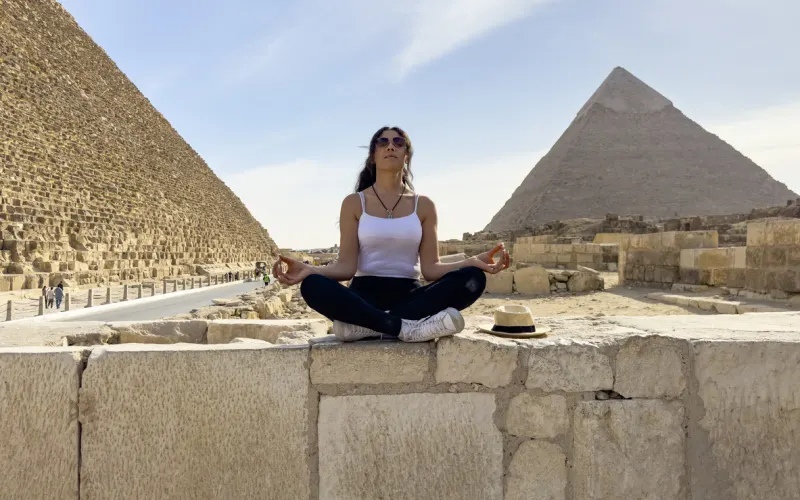

Rising from the desert sands for more than 4,500 years, the Egyptian pyramids rank among the most extraordinary monuments ever created by human civilization. Far more than elaborate tombs, these structures embodied the full complexity of ancient Egyptian culture — royal power, religious devotion, mathematical precision, and an unwavering belief in eternal life. While the pyramids of the Giza Plateau draw the greatest attention, more than 100 pyramids are scattered across Egypt, each contributing to a broader architectural legacy that continues to challenge and inspire historians, engineers, and archaeologists worldwide.
1. The Pyramids Were Built as Royal Tombs
The ancient Egyptians understood death not as an ending but as a transition. Pharaohs, regarded as divine intermediaries between the human and divine realms, required monuments worthy of their eternal journey. Pyramid burial chambers were filled with jewelry, statuary, furniture, provisions, and sacred objects intended to sustain the ruler in the afterlife. Walls were inscribed with religious texts and protective symbols designed to guide the pharaoh safely into the next world — transforming these structures into carefully engineered gateways between life and eternity.

2. The Great Pyramid Is the Last Standing Ancient Wonder
Constructed for Pharaoh Khufu during the Fourth Dynasty, the Great Pyramid of Giza is the sole surviving structure from the original Seven Wonders of the Ancient World. At its original height of approximately 146 meters (481 feet), it held the distinction of being the tallest man-made structure on Earth for nearly 3,800 years. What distinguishes the Great Pyramid is not merely its scale, but the extraordinary precision of its execution — a feat that continues to occupy architects and engineers who struggle to fully explain how it was achieved with ancient tools alone.
3. The Pyramids Are Over 4,500 Years Old
The majority of Egypt's major pyramids were constructed during the Old Kingdom, specifically within the Fourth Dynasty between 2600 and 2500 BCE — a period historians have aptly termed the Age of the Pyramid Builders. That these structures remain standing after four and a half millennia is itself a testament to the sophistication of ancient Egyptian engineering, materials selection, and construction methodology.
4. The Pyramids Were Built with Remarkable Precision
The Great Pyramid is oriented with near-perfect alignment to the four cardinal directions — a feat accomplished without GPS, modern surveying equipment, or mechanized tools. Scholars believe ancient builders relied on astronomical observation, mathematical calculation, measuring ropes, and an intimate understanding of celestial movements to achieve this accuracy.
The level foundations and geometric symmetry of the Giza pyramids remain a subject of admiration and study among contemporary architects and structural engineers.

5. Skilled Workers Built the Pyramids — Not Slaves
The long-held popular image of enslaved laborers constructing the pyramids has been comprehensively overturned by archaeological evidence. Excavations near Giza uncovered workers' villages complete with bakeries, medical facilities, sleeping quarters, and dedicated burial sites — indicators of a respected, organized workforce. These laborers were skilled tradespeople: architects, stonemasons, engineers, transport specialists, and artisans who operated within a highly structured national project, receiving food, shelter, and medical care in return for their service.
6. Egypt Contains More Than 100 Pyramids
The Giza Plateau represents only the most celebrated chapter in a much larger story. Egypt is home to more than 100 pyramids distributed across multiple regions, ranging from well-preserved monuments to structures significantly worn by time. The earliest among them is the Step Pyramid of Djoser at Saqqara, designed by the architect Imhotep. This pioneering structure marked a decisive turning point in Egyptian architectural ambition and laid the conceptual groundwork for the smooth-sided pyramids that followed.
7. The Pyramids Reflect Advanced Astronomical Knowledge
Astronomy was deeply embedded in ancient Egyptian religious and intellectual life. Many researchers have identified an alignment between the three Giza pyramids and Orion's Belt, a constellation associated with Osiris, the god of the afterlife. The ancient Egyptians systematically studied celestial movements for agricultural planning, religious ceremony, and architectural orientation — and the pyramids stand as enduring evidence of how sophisticated that understanding had become.
8. Millions of Stone Blocks Were Used in Construction
The Great Pyramid alone incorporates an estimated 2.3 million limestone and granite blocks. Individual blocks within the King's Chamber weigh as much as 70 tons. Most stone was quarried from sites in the immediate vicinity of Giza, while granite was transported from Aswan — hundreds of kilometers to the south. Workers are believed to have used wooden sleds, ramps, ropes, and water lubrication to move these immense blocks across the desert terrain with remarkable efficiency.

9. Construction Spanned Decades
Pyramid construction was a sustained national undertaking requiring thousands of workers and generations of planning. Historians estimate the Great Pyramid alone took between 20 and 30 years to complete. The process encompassed quarrying and transporting stone, engineering internal chambers, constructing ramps, and placing each block with a level of precision that left virtually no margin for error across millions of individual components.
10. The Pyramids Once Gleamed White Across the Desert
The rough, sandy appearance of the pyramids today bears little resemblance to their original form. Each structure was originally encased in polished white Tura limestone, which reflected sunlight with striking brilliance across the desert landscape. Over centuries, seismic activity and systematic stone removal by later builders stripped away much of this outer casing, exposing the rougher inner blocks that characterize the monuments today.
11. Hidden Chambers Remain to Be Discovered
Despite centuries of exploration and excavation, the pyramids continue to yield new secrets. Advanced scanning technologies, including muon tomography and thermal imaging, have identified previously unknown voids and unexplored spaces within the Great Pyramid in recent years. These findings suggest that significant architectural features may yet remain undiscovered beneath the ancient stone — a possibility that continues to drive modern Egyptological research.
12. Each Pyramid Formed Part of a Larger Sacred Complex
No pyramid stood in isolation. Each formed the centerpiece of an extensive funerary complex encompassing mortuary temples, ceremonial causeways, subsidiary queen pyramids, and burial sites for nobles and court officials.
These complexes functioned as sacred cities of the dead, designed to sustain ongoing religious rituals honoring the deceased pharaoh and maintaining his spiritual connection to the divine.
13. The Great Sphinx Guards the Giza Plateau
Standing sentinel beside the pyramids, the Great Sphinx is among Egypt's most iconic and enigmatic monuments. Carved from a single formation of natural limestone, the statue combines the body of a lion with the head of a pharaoh — most likely Khafre. As a symbol of royal authority and divine protection, the Sphinx was positioned to guard the sacred complex, embodying the strength and vigilance attributed to the ruling pharaoh.

14. Pyramid Architecture Evolved Over Centuries
Egyptian pyramid design was not static but developed gradually through a process of architectural experimentation. Early structures such as the Step Pyramid of Djoser consisted of stacked mastaba levels. Subsequent builders refined angles, materials, and proportions through a series of experimental forms — including the Bent Pyramid and Red Pyramid at Dahshur — before arriving at the refined smooth-sided design perfected at Giza. This evolution reflects the progressive accumulation of engineering knowledge across multiple generations of builders.
15. The Pyramids Carried Profound Spiritual Symbolism
Every dimension of pyramid construction was imbued with religious significance. The triangular form was understood to represent the descending rays of the sun — a physical manifestation of the connection between the earthly realm and the divine. Orientation, internal layout, and the objects placed within burial chambers were all determined by theological requirements rather than practical convenience alone. For the ancient Egyptians, the pyramid was not merely a monument but a functional instrument for securing the pharaoh's passage into immortality.
The Egyptian pyramids endure as monuments to human ambition, intellectual sophistication, and spiritual conviction. They represent the convergence of advanced engineering, astronomical knowledge, organized labor, and religious devotion on a scale unmatched in the ancient world.
Whether approached as architectural masterpieces, historical documents, or unresolved mysteries, the pyramids remain among the most significant achievements in the history of human civilization — and a compelling reason to look more carefully at what ancient Egypt was truly capable of.
Who actually built the Egyptian pyramids?
Skilled Egyptian tradespeople — not slaves. Archaeological discoveries near Giza uncovered workers' villages with bakeries, medical facilities, and burial sites, confirming a well-organized, well-supported workforce of engineers, stonemasons, and artisans.
How old are the Egyptian pyramids?
Most major pyramids were built during the Fourth Dynasty between 2600 and 2500 BCE, making them over 4,500 years old. The Step Pyramid of Djoser at Saqqara is the earliest known example, predating the Giza monuments.
How long did it take to build the Great Pyramid?
Historians estimate between 20 and 30 years, involving thousands of workers quarrying, transporting, and precisely placing an estimated 2.3 million limestone and granite blocks.
How were the pyramids built without modern technology?
Through astronomical observation, mathematical calculation, measuring ropes, wooden sleds, ramps, and water lubrication. The Great Pyramid's near-perfect cardinal alignment remains a remarkable engineering achievement by any standard.
What did the pyramids originally look like?
They were encased in polished white Tura limestone that reflected sunlight brilliantly across the desert. Most of this outer casing was removed over centuries by later builders, revealing the rough inner blocks visible today.
Are there undiscovered chambers inside the pyramids?
Possibly. Recent scans using muon tomography and thermal imaging have identified unexplored voids within the Great Pyramid, suggesting undiscovered architectural features may still remain beneath the ancient stone.
How many pyramids does Egypt have?
More than 100, spread across multiple regions beyond the Giza Plateau. They range from well-preserved monuments to heavily eroded structures, with the Step Pyramid of Djoser at Saqqara being the earliest surviving example.
What is the spiritual significance of the pyramid shape?
The triangular form represented the rays of the sun and the connection between earth and the divine. Every element of pyramid construction — orientation, layout, and burial contents — was governed by religious belief, making the pyramid a spiritual instrument as much as a tomb.