
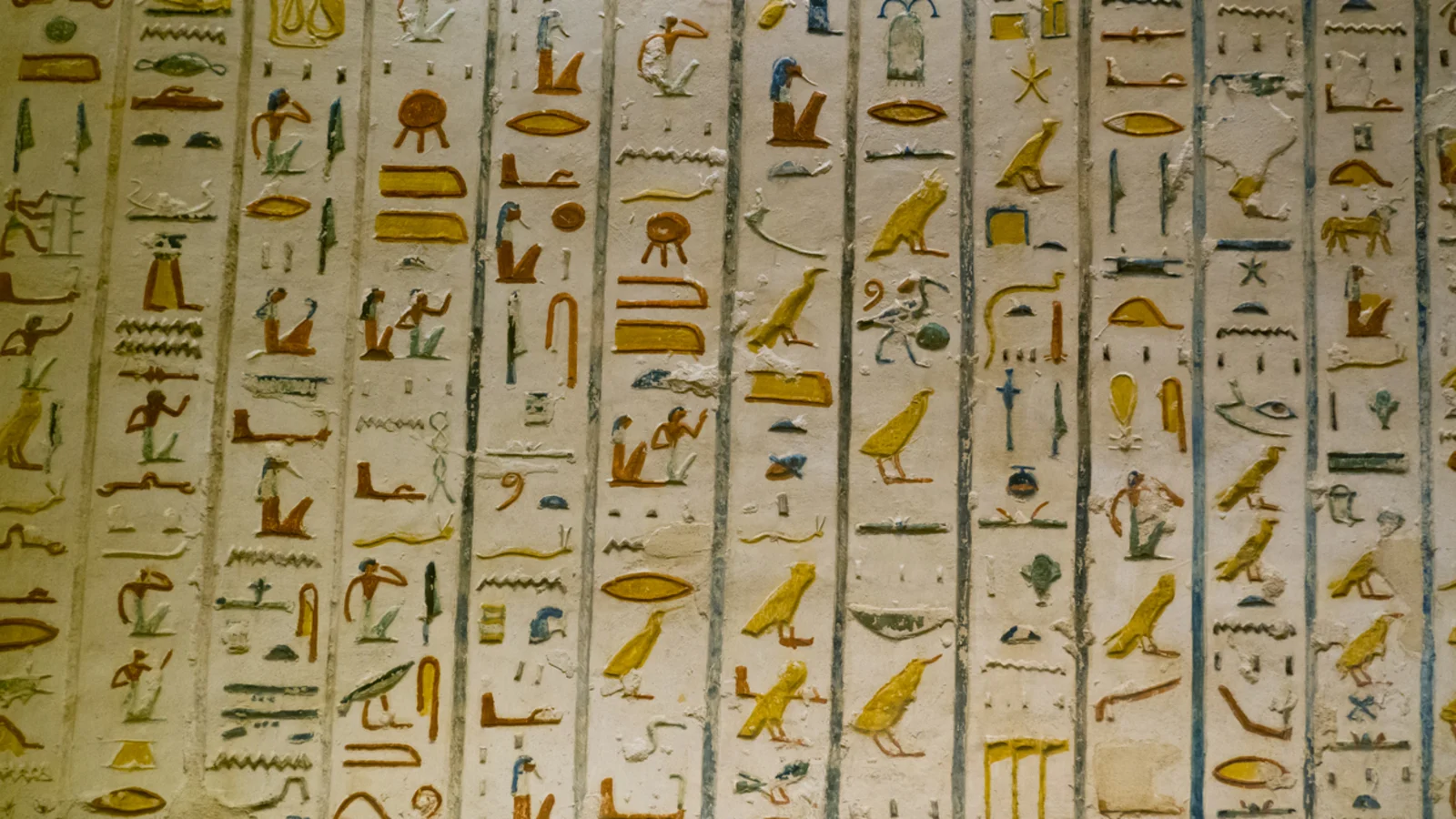

Few places on earth let you hear, read, and touch 5,000 years of human speech in a single trip. Egypt is one of them. The story of Egyptian languages stretches from the earliest carved symbols on temple walls to the lively dialect spoken in Cairo's cafés today, an unbroken thread connecting the world of the pharaohs to modern life along the Nile. Over the centuries, Egyptian hieroglyphs gave way to faster scripts for daily use, evolved into the Coptic language still heard in churches across the country, and eventually made room for Egyptian Arabic, now the most widely understood dialect in the Arab world. In this guide, we trace that remarkable journey stage by stage, from sacred script to street talk, and show you where you can still see, hear, and experience each chapter of it in Egypt today.

The ancient Egyptian language holds a remarkable record: it was written and spoken continuously for longer than almost any other language in history. Scholars divide its long life into five major stages. Old Egyptian was the language of the pyramid builders, recorded from around 2600 BC. Middle Egyptian followed and became the classical form, used for literature, religious texts, and monument inscriptions for centuries, even after people stopped speaking it day to day. Late Egyptian took over in everyday speech and writing during the New Kingdom, the era of Ramses II and Tutankhamun. Then came Demotic Egyptian, a faster script and evolving tongue used for business and daily life, and finally the Coptic language, the last stage of ancient Egyptian, written in Greek letters and still alive in church services today.
The story doesn't end there. After the Arab conquest in the 7th century AD, Arabic gradually became the language of Egypt, developing over time into the Egyptian Arabic spoken by more than 100 million people today. Each stage left its mark on the land, in carved temple walls, papyrus contracts, monastery hymns, and the everyday greetings you'll hear the moment you land in Cairo. The sections below walk through each era, one by one.

When most people picture ancient Egypt, they picture Egyptian hieroglyphs: rows of birds, eyes, and reeds carved into stone. The Egyptians themselves called this writing "the words of the gods," and for good reason. Hieroglyphs were reserved for temples, tombs, and royal monuments, places where words were meant to last forever. And they did. This script remained in use for more than 3,500 years, from before the pyramids until the last known inscription was carved at Philae Temple in 394 AD.
How Hieroglyphs Worked
Hieroglyphs look like simple picture writing, but the system was far cleverer than that. Some signs stood for whole words, so a drawing of the sun could simply mean "sun." Others stood for sounds, working much like letters in our alphabet, which is how scribes spelled out names and foreign words. A third group of signs carried no sound at all; they were placed at the end of a word as a silent clue to its meaning, telling the reader whether the word referred to a person, a place, or an action. Combined, these three types of signs gave scribes a writing system flexible enough to record everything from prayers and poetry to tax records and royal decrees.
Where to See Hieroglyphs Today
The best part for travellers is that hieroglyphs are everywhere in Egypt, and often exactly where they were carved thousands of years ago. At Karnak Temple in Luxor, entire walls and towering columns are covered in inscriptions celebrating the gods and the pharaohs who built them. Across the river in the Valley of the Kings, tomb walls glow with painted hieroglyphs guiding pharaohs through the afterlife, with colours still vivid after 3,000 years. And at Saqqara, near Cairo, the Pyramid of Unas holds the Pyramid Texts, the oldest religious writings ever discovered, carved into the burial chamber around 2300 BC.
Hieratic: The Everyday Cousin of Hieroglyphs
Carving detailed pictures into stone takes time, and scribes handling daily paperwork needed something faster. Their answer was hieratic, a flowing, simplified version of hieroglyphs written in ink on papyrus. Think of it as the handwriting to hieroglyphs' formal print. Hieratic handled letters, accounts, and literature for centuries, until an even quicker script emerged, one that would define the next chapter of the story: Demotic.
By around 650 BC, Egypt's scribes had developed something even faster than hieratic: a script so streamlined that its signs barely resembled the picture writing they came from. The Greeks called it "demotic," meaning "of the people," and the name fit perfectly. Demotic Egyptian became the script of everyday life for nearly a thousand years, remaining in use until the 5th century AD.
If hieroglyphs recorded the words of gods and kings, Demotic recorded the words of everyone else. Marriage contracts, property sales, loan agreements, personal letters, receipts, and court documents were all written in Demotic, giving historians an extraordinary window into how ordinary Egyptians lived, traded, argued, and made up. It wasn't only paperwork, either. Some of Egypt's most entertaining stories survive in Demotic, including tales of magicians, adventures, and clever heroes that were the popular fiction of their day.
Demotic also earned a permanent place in history for another reason. When priests in 196 BC carved a decree honoring King Ptolemy V onto a granite slab, they wrote it three times: in hieroglyphs for the gods, in Demotic for the people, and in Greek for the ruling class. That slab is the Rosetta Stone, and its three matching texts would one day hand scholars the key to unlocking every script Egypt had ever written.

For nearly 1,500 years after the last hieroglyph was carved, nobody on earth could read ancient Egyptian. That changed thanks to the Rosetta Stone, discovered by chance in 1799 near the town of Rashid in the Nile Delta. Because the stone carried the same decree in hieroglyphs, Demotic, and Greek, scholars finally had a code-breaking tool: they could read the Greek, then work backwards. In 1822, French scholar Jean-François Champollion made the breakthrough, proving that hieroglyphs recorded both sounds and ideas, and cracking the system at last. His discovery reopened 3,000 years of Egyptian history in the Egyptians' own words. The stone itself is displayed in the British Museum in London, though you can see a replica at Rashid and countless original trilingual inscriptions across Egypt's museums.

The final chapter of ancient Egyptian is the Coptic language: the same tongue of the pharaohs, now written in Greek letters with a few extra signs for Egyptian sounds. Coptic flourished as Egypt embraced Christianity, and although Arabic replaced it in daily speech centuries ago, it never died. It survives today in the hymns and prayers of the Coptic Orthodox Church. Visitors can hear it during services in the historic churches of Coptic Cairo or at the ancient desert monasteries of Wadi El Natrun, where monks still chant in words echoing back to the pharaohs.

Arabic arrived with the Arab conquest in the 7th century and gradually became Egypt's everyday language, evolving into the Egyptian Arabic spoken today. Thanks to Egypt's dominance in Arab cinema, television, and music, it is the most widely understood dialect in the Arab world, from Morocco to Iraq. Yet the older layers never fully vanished: Egyptian Arabic still carries words inherited from Coptic and even ancient Egyptian, especially in food, farming, and place names. When you chat with a Cairo shopkeeper, you're hearing a living language with 5,000 years of history folded inside it.
Here's what makes Egypt truly special: this entire linguistic journey can unfold in a single day of travel. Spend your morning reading Egyptian hieroglyphs on the columns of Karnak or the tomb walls of the Valley of the Kings. At noon, step into a church in Coptic Cairo and hear the last living stage of the ancient tongue in hymns sung for centuries. By evening, settle into a Cairo café and let the rhythm of Egyptian Arabic carry on around you, the newest voice in a 5,000-year conversation. Our Egypt tours bring this story to life with expert Egyptologist guides who can read the walls for you, explain what the scribes wrote, and connect every era, from Saqqara's Pyramid Texts to the streets of modern Cairo. Browse our Egypt tour packages and start planning your journey through the ages.
Frequently Asked Questions
1. What language did ancient Egyptians speak?
Ancient Egyptians spoke Egyptian, which evolved through five stages over 4,000 years: Old, Middle, and Late Egyptian, then Demotic, and finally Coptic.
2. Are Egyptian hieroglyphs a language or a script?
Hieroglyphs are a script, not a language; they were one of several writing systems used to record ancient Egyptian.
3. Is the Coptic language still spoken today?
Coptic is no longer a daily spoken language, but it survives in the liturgy of the Coptic Orthodox Church, where hymns and prayers are still chanted in it.
4. What was Demotic Egyptian used for?
Demotic was the everyday script of Egypt from around 650 BC to the 5th century AD, used for contracts, letters, business records, and popular stories.
5. Who deciphered Egyptian hieroglyphs?
French scholar Jean-François Champollion deciphered hieroglyphs in 1822 using the Rosetta Stone, which carried the same text in hieroglyphs, Demotic, and Greek.
6. What language is spoken in Egypt today?
Egyptians today speak Egyptian Arabic, the most widely understood Arabic dialect in the Arab world, thanks to Egyptian cinema, music, and television.


