
The Valley of the Kings (Arabic: وادي الملوك, Wadi el-Muluk) is a renowned archaeological site in Egypt, located on the west bank of the Nile River near Luxor. This sacred valley served as the principal burial ground for the pharaohs of the New Kingdom (18th to 20th dynasties, roughly 1550–1070 BCE), including the famous tomb of Tutankhamun. The valley is a UNESCO World Heritage Site and remains one of the most significant and mysterious ancient burial sites in the world.
Location and Geography
Nestled behind the cliffs of Deir el-Bahari, the Valley of the Kings lies within the Theban Necropolis, opposite modern-day Luxor. Its location was chosen strategically — hidden within the desert hills to deter tomb robbers, yet aligned with the sacred sun god Ra, symbolizing the pharaohs’ journey to the afterlife.
History and Purpose
The valley was used for over 500 years as the royal necropolis of the Egyptian New Kingdom. Unlike the pyramids of the Old Kingdom, which were highly visible and vulnerable, the pharaohs of the New Kingdom opted for rock-cut tombs concealed in the cliffs.
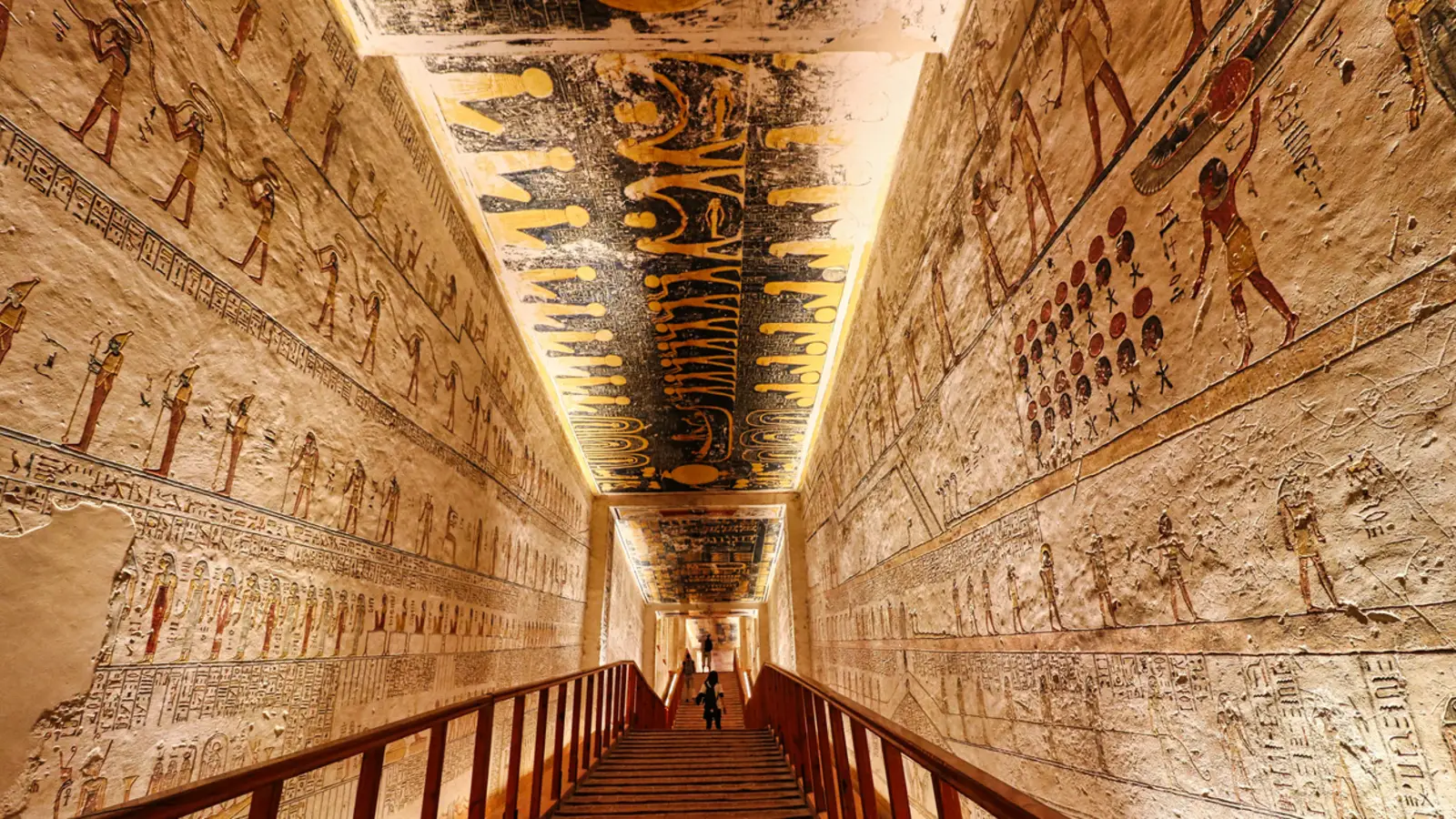
The tombs were designed to ensure a safe passage to the afterlife. Walls were often adorned with funerary texts, such as the Book of the Dead, Amduat, and Book of Gates, depicting the sun god’s nightly journey through the underworld and guiding the king’s soul to eternal life.

Famous Tombs and Discoveries
More than 60 tombs have been discovered to date, varying from simple pits to elaborate multi-chambered structures. Key tombs include:
-
KV62 – Tomb of Tutankhamun: Discovered by Howard Carter in 1922, this is the most famous find due to the nearly intact burial and incredible treasures it held.
-
KV35 – Tomb of Amenhotep II: Contained a cache of royal mummies, including Thutmose IV and possibly Queen Tiye.
-
KV5 – Tomb of the sons of Ramesses II: One of the largest tombs, with over 120 chambers.
-
KV17 – Tomb of Seti I: Known for its exceptional artistry and length.
Despite efforts to prevent looting, most tombs were robbed in antiquity. Still, modern archaeologists continue to uncover new chambers, funerary goods, and inscriptions.
Tomb Architecture and Sacred Art
Behind every tomb in the Valley of the Kings lies a feat of engineering as remarkable as the treasures it once held. Working with little more than copper chisels, wooden mallets and oil lamps, the craftsmen of Deir el-Medina cut long corridors and stepped chambers deep into the soft Theban limestone, sometimes descending more than a hundred metres into the hillside. These artisans were no ordinary labourers; they lived in a dedicated village, passed their skills down through generations, and were among the most respected workers in the kingdom.
The layout itself carried meaning. A typical royal tomb followed a descending axis of corridors, antechambers and pillared halls, leading at last to the burial chamber where the pharaoh's sarcophagus rested. Every surface became a canvas. Painters and scribes covered the walls in vivid colour with funerary texts designed to guide the king safely through the afterlife — the Amduat charting the sun god's nightly journey, the Book of Gates marking the perilous thresholds of the underworld, and passages from the Book of the Dead offering spells of protection. To stand inside one of Ancient Egypt's royal tombs today is to read a 3,000-year-old map of the journey to eternity, still glowing on the rock.
Mysteries and Hidden Meanings
The Valley is shrouded in ancient mystery. Some researchers believe more undiscovered tombs remain hidden beneath the desert floor. Recent radar scans near Tutankhamun's tomb suggested the possibility of hidden chambers — perhaps the final resting place of Queen Nefertiti, though no definitive evidence has been found.
Symbolically, the valley’s location reflects deep religious significance: the west bank of the Nile was associated with death and rebirth, mirroring the daily setting of the sun and the journey to the underworld.

Conservation and the Threats Facing the Tombs
For all their permanence, the tombs of the Valley of the Kings are surprisingly fragile, and protecting them is a constant battle. The greatest danger is also the most ironic: people. Every visitor exhales humidity and carbon dioxide, and over millions of guests a year this raises moisture levels inside the sealed chambers, encouraging salt crystallisation and microbial growth that slowly lift the ancient paint from the walls. Flash floods pose a second threat — though rare in this desert valley, sudden downpours can send water and debris pouring into open tombs, as they have done repeatedly throughout history.
To ease the strain, Egypt's authorities now rotate which tombs are open to the public, closing the most vulnerable for periods of recovery, and limit access to the most delicate burials. The most striking solution stands near the valley entrance: an exact, full-scale replica of Tutankhamun's tomb, created using high-resolution scanning so that travelers can experience its splendour without adding to the wear on the original. These measures, alongside modern climate monitoring and careful visitor management, are what will keep Ancient Egypt's royal tombs standing for the generations still to come.
Visiting the Valley Today
Today, the Valley of the Kings is a major tourist attraction and a centerpiece of any Egypt tour. Many tombs are open to the public on a rotating basis to prevent damage. Visitors can view:
-
Stunning hieroglyphic carvings
-
Intricate ceiling art showing celestial maps
-
Sarcophagus chambers and burial architecture
To protect fragile artifacts, replica tombs of Seti I and Tutankhamun are now open nearby for immersive experiences without harming the originals.
Legacy and Cultural Impact
The Valley has inspired countless books, films, and scholarly works. Its discovery significantly shaped our understanding of Ancient Egyptian beliefs, royal practices, and daily life in the New Kingdom.
From the glamour of Tutankhamun’s golden mask to the solemn grandeur of forgotten tombs, the Valley of the Kings continues to captivate the world as a gateway to Egypt's timeless legacy.
Plan Your Visit
Whether you're an archaeology enthusiast or a curious traveller, exploring the Valley of the Kings is a once-in-a-lifetime experience. Include it in your Egypt tour package and uncover the secrets of Egypt’s eternal pharaohs.
Frequently Asked Questions
1. Where is the Valley of the Kings located?
The Valley of the Kings sits on the west bank of the Nile near Luxor in southern Egypt, opposite the ancient city of Thebes.
2. Why were pharaohs buried in the Valley of the Kings?
From around 1550 BCE, New Kingdom rulers chose this hidden desert valley for their royal tombs, hoping its remote, guarded setting would shield their treasures from grave robbers.
3. How many tombs are in the Valley of the Kings?
Archaeologists have uncovered 65 tombs so far, ranging from simple pits to vast multi-chamber complexes — and excavations continue, so the count may still grow.
4. Which is the most famous tomb in the Valley of the Kings?
The tomb of Tutankhamun (KV62), found almost intact by Howard Carter in 1922, is the most famous of Ancient Egypt's royal tombs.
5. Can you go inside the tombs in the Valley of the Kings?
Yes. A standard ticket lets you enter three tombs, while a few — including Tutankhamun's and Seti I's — require a separate ticket.
6. Is the Valley of the Kings worth visiting?
Absolutely. Stepping inside these 3,000-year-old royal tombs to see their vivid wall paintings is one of the most unforgettable experiences in all of Egypt.