
Introduction
For more than 4,500 years, a colossal lion with a human face has watched the sun rise over the Nile Valley. The Great Sphinx of Giza is the largest monolithic statue on earth, carved directly from the living bedrock of the Giza plateau, and it remains one of the most recognizable objects ever made by human hands.
What makes the Sphinx extraordinary is not only its scale. It is what we still don't know. No inscription from the age of its builders names its maker, explains its purpose, or records the day it was finished. The monument that has answered questions for millions of visitors has never answered the most basic ones about itself.
This guide covers everything worth knowing before you stand in front of it: where the Giza Sphinx sits, how it was built, who built it, what happened to its nose, which theories are credible and which are not, and what else is worth seeing while you're on the plateau.
The Naming
The word sphinx is Greek, not Egyptian. It comes from Greek mythology, where the sphinx was a winged monster who posed riddles to travellers and destroyed those who answered wrongly. Greek visitors to Egypt applied that familiar name to an unfamiliar statue, and it stuck.
The ancient Egyptians called it something else entirely. By the New Kingdom, roughly a thousand years after it was carved, the statue was known as Horemakhet — "Horus of the Horizon" — a solar deity connected to the rising sun. The Greeks rendered this as Harmakhis. Another Egyptian phrase, shesep-ankh, meaning "living image," may have been the actual source of the Greek word sphinx, though scholars disagree.
In Arabic, the monument is Abu al-Hawl, usually translated as "Father of Dread" or "Father of Terror." The name likely arose in the medieval period, when the statue stood buried to its shoulders in sand, a giant weathered face emerging from the desert with no body attached.
What no one has ever found is the name given to it by the people who carved it. The Old Kingdom texts are silent.
Location of Sphinx

The Great Sphinx of Giza stands on the Giza plateau, on the west bank of the Nile, roughly 13 miles (20 km) southwest of central Cairo and about 6 miles (10 km) west of the river itself. The west bank was the land of the dead in Egyptian cosmology — the direction of the setting sun — which is why the entire necropolis was built here.
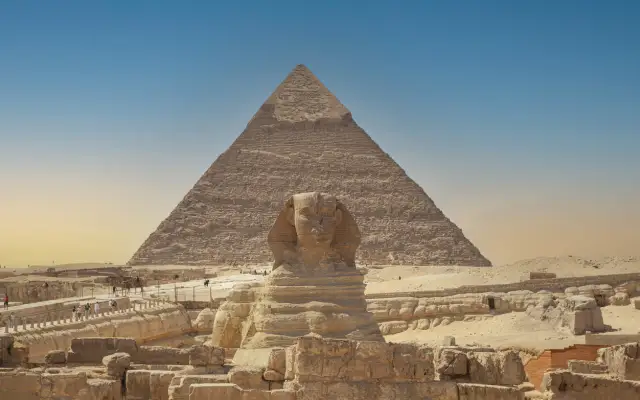
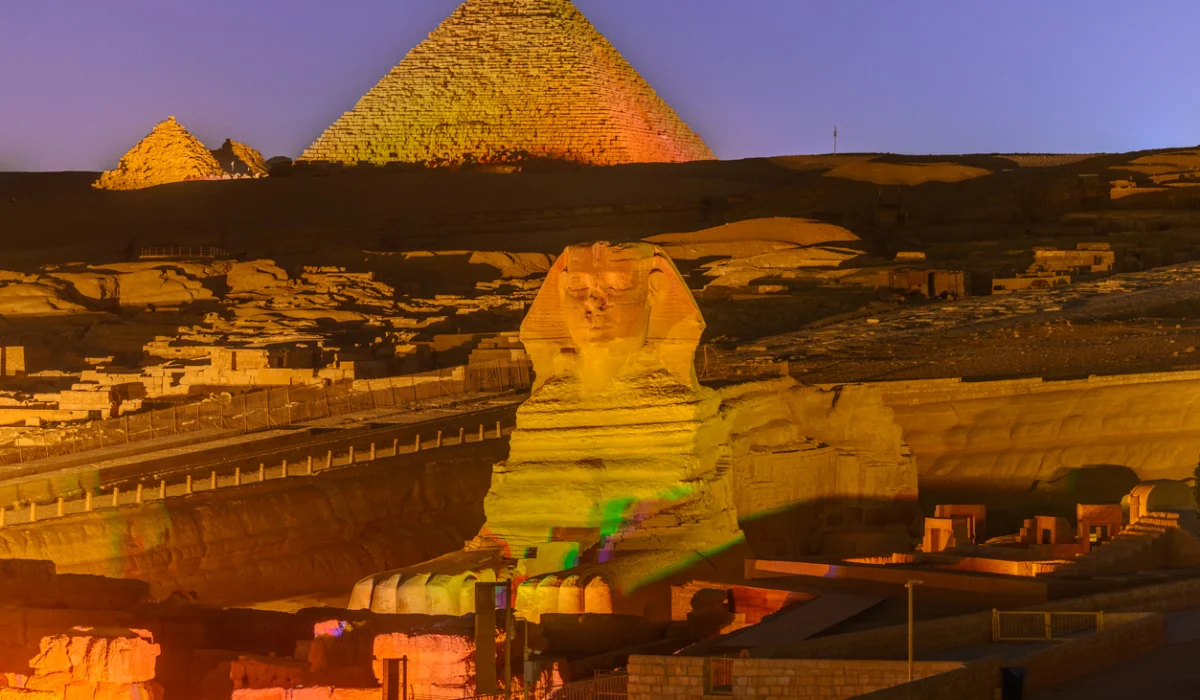
The Sphinx sits at the eastern edge of the plateau, below and slightly forward of the pyramid complex. Directly behind it rises the Pyramid of Khafre; behind that, the Great Pyramid of Khufu. The statue faces due east, aligned so that it meets the sunrise, and on the equinoxes, the sun rises almost precisely over its right shoulder.
Two temples are associated with it. The Sphinx Temple lies immediately in front of the paws, and the Valley Temple of Khafre sits just to its south, connected by a causeway running up to Khafre's pyramid. The three structures form a single architectural unit, which is the strongest evidence linking the Sphinx to Khafre's reign.
The Grand Egyptian Museum now stands roughly a mile from the plateau, which makes it easy to pair the two in a single day.
Structure and Building
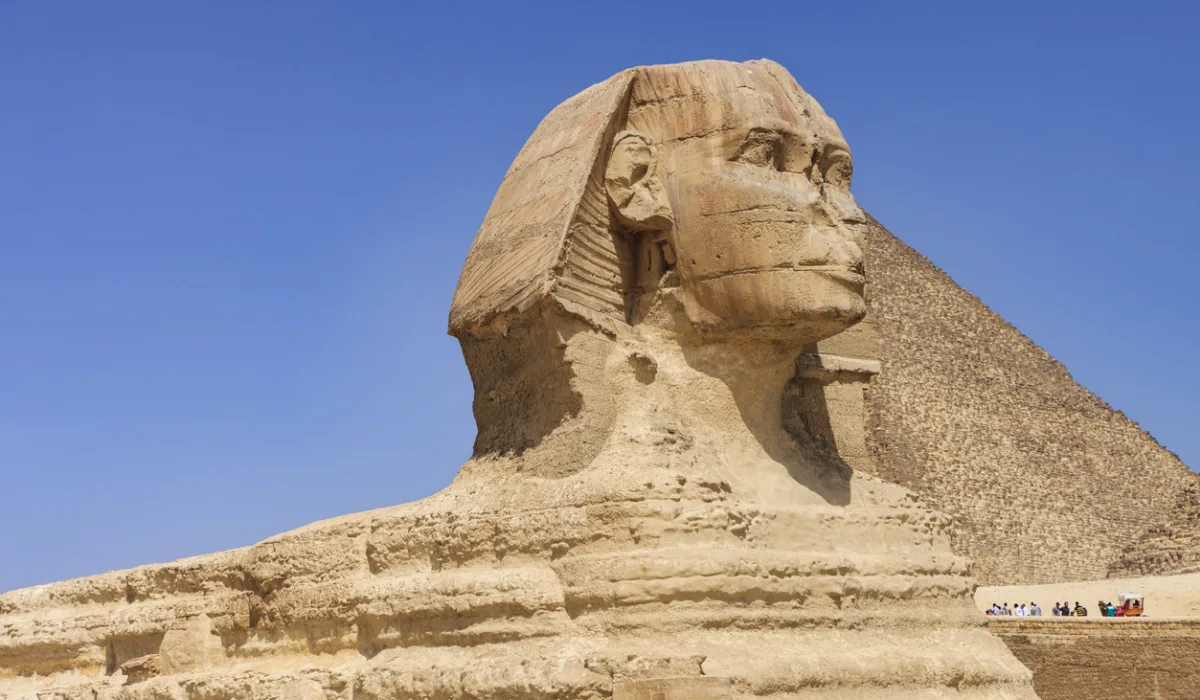
The Sphinx measures approximately 240 feet (73 m) long, 66 feet (20 m) high, and 19 feet (6 m) wide at its widest point. It has the recumbent body of a lion and the head of a man wearing the nemes, the striped royal headdress of a pharaoh, with the remains of a uraeus — the rearing cobra — above the brow.
It was not built. It was excavated. Workers quarried a horseshoe-shaped ditch out of the limestone bedrock and left a core of stone standing in the middle, then carved that core into the lion form. The blocks removed from the ditch appear to have been used in the Sphinx Temple in front of it, which means the temple and the statue were almost certainly produced in the same operation.
This method explains the monument's biggest structural weakness. The bedrock of the Mokattam Formation is not uniform. It runs in layers of different hardness — a hard band at the base, a soft and crumbly middle section, and harder stone again at the top. The head was carved from good rock and has survived remarkably well. The body was carved from the soft middle layers and has eroded severely, which is why so much of the lower body is now clad in restoration blocks.
The paws are not part of the original monolith. They were built up from limestone blocks, and the front paws you see today extend some 50 feet forward from the chest. Traces of red pigment survive on the face, and yellow and blue on the headdress, so the Sphinx was almost certainly painted in antiquity — a red-brown lion with a brightly striped headcloth, not the sand-colored monument we photograph today.
History
The mainstream consensus, held by nearly all Egyptologists, dates the Sphinx to the Fourth Dynasty of the Old Kingdom, during the reign of Khafre, around 2558–2532 BC. The evidence is circumstantial but coherent: the Sphinx enclosure, the Sphinx Temple, and Khafre's causeway and Valley Temple were built with the same masonry techniques and form a unified plan, and the face bears a general resemblance to confirmed statues of Khafre.
Not everyone agrees on which king. The French Egyptologist Vassil Dobrev has argued that Djedefre, Khafre's elder half-brother, built the Sphinx as a monument to their father Khufu — which would push the date back slightly. A minority have proposed Khufu himself. The debate is unresolved because no Old Kingdom text mentions the statue at all.
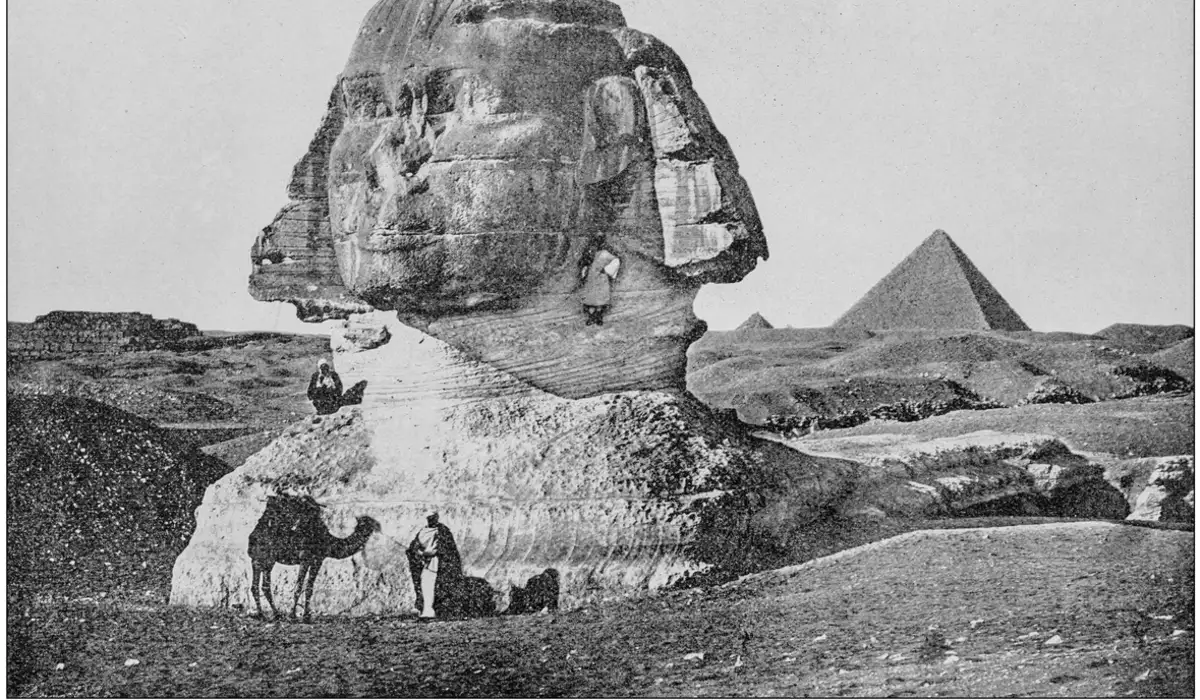
After the Old Kingdom the Sphinx disappeared under sand, and this became its permanent condition. For most of the last four millennia the Great Sphinx of Giza was buried to the neck.
The most famous chapter in its history is recorded on the Dream Stele, a granite slab still standing between the paws. It was placed there by Thutmose IV around 1400 BC. The text tells how the young prince, hunting on the plateau, fell asleep in the Sphinx's shadow. The god Horemakhet appeared to him in a dream and promised him the throne of Egypt if he would clear the sand from the statue's body. He cleared it. He became pharaoh. Whether the dream was real or the stele was clever propaganda for a prince who may not have been the obvious heir, it tells us the monument was already ancient and already sacred by the New Kingdom.
The Greeks and Romans came, wrote about it, and left offerings. Then the sand returned. Medieval Arab writers described a colossal head rising from the desert. It stayed that way until the modern era.
Mysteries and Theories About the Sphinx
The silence of the Old Kingdom record has created space for a large body of alternative theory. Some of it is serious scholarship. Most of it is not. Here is what's actually being argued.
The water erosion hypothesis. In the early 1990s, geologist Robert Schoch, working with author John Anthony West, argued that the deep vertical weathering channels in the Sphinx enclosure walls were caused by prolonged rainfall rather than wind and sand. Since Egypt has not had that climate since roughly 5000 BC or earlier, Schoch proposed a far older date for the original carving — with the head recarved later. Egyptologists and most geologists reject the conclusion, arguing that the erosion patterns are explained by the varying hardness of the limestone layers, salt crystallization, and groundwater. The debate has never been fully settled to everyone's satisfaction, but the archaeological evidence for a Fourth Dynasty date remains substantial and the evidence for an Ice Age civilization in Egypt remains nonexistent.
The head is too small. A common observation, and a fair one — the head is noticeably out of proportion with the body. The conventional explanation is the geology again: the hard upper stratum available for the head simply didn't have the volume for a larger one. The alternative explanation is that an original, larger head (a lion's, some say) was recarved into a pharaoh's face at a later date. No physical evidence for a recarving has been produced.
The Hall of Records. The American psychic Edgar Cayce claimed in the 1930s that a chamber containing the archives of Atlantis lay beneath the Sphinx's paws, to be discovered near the end of the twentieth century. It was not. Seismic and radar surveys have detected some cavities and fissures in the bedrock beneath and around the statue, along with several known tunnels and shafts of ancient or modern origin. None has produced a hidden library.
The Orion and Leo alignments. Robert Bauval and Graham Hancock have argued that the Giza monuments encode a specific sky-date, and that a lion-shaped statue facing east makes most sense in an era when the constellation Leo rose at the vernal equinox — around 10,500 BC. The mathematics of precession is sound; the leap from a sky alignment to a lost civilization is not.
The honest position is that the Sphinx is genuinely mysterious in the mundane, frustrating way that real archaeology is mysterious. We do not know who ordered it, why, or exactly when. That's remarkable enough without Atlantis.
The Famous Sphinx Nose
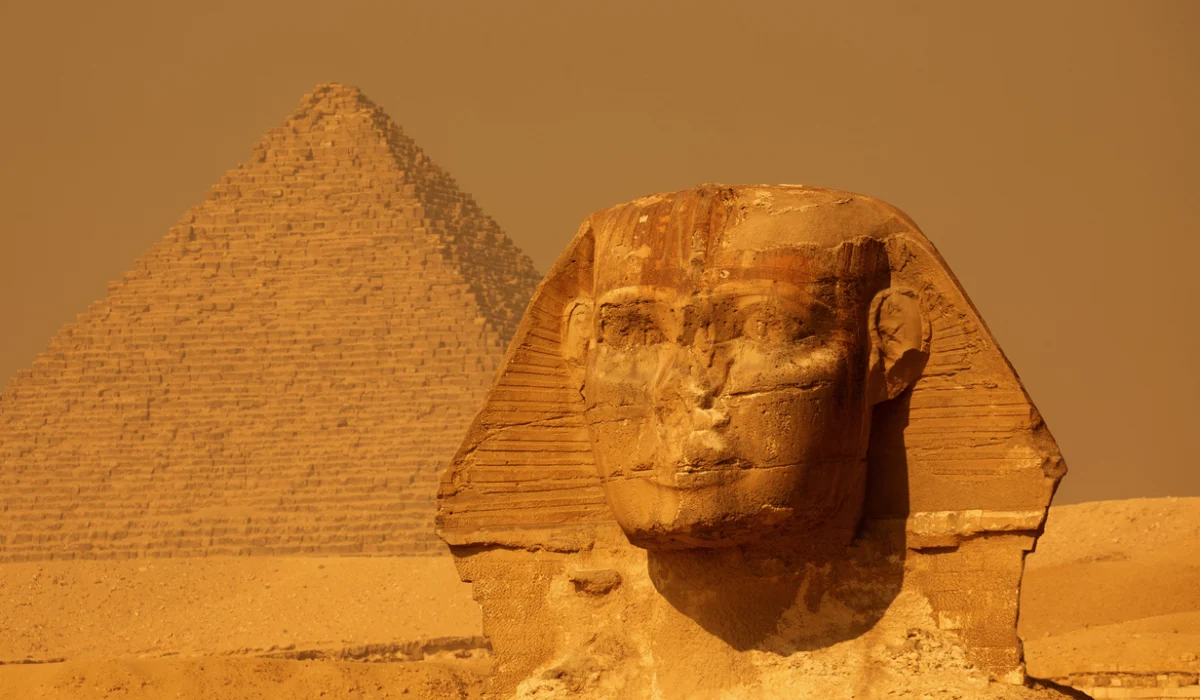
The Sphinx has no nose. The missing piece was about three feet wide.
The story most people have heard blames Napoleon's soldiers, who supposedly used the face for artillery practice during the French campaign of 1798. This is false, and the disproof is simple. Sketches and engravings made by the Danish naval captain Frederic Louis Norden, who visited Egypt in 1737 and published his drawings decades before Napoleon was born as a public figure, clearly show the Sphinx already noseless.
The likelier account comes from the fifteenth-century Egyptian historian al-Maqrizi. He records that in 1378 AD a Sufi named Muhammad Sa'im al-Dahr found local peasants making offerings to the statue in hope of a good harvest. Enraged at what he saw as idolatry, he defaced it. According to al-Maqrizi, the people of the area were so angry that the man was killed for what he had done.
The physical evidence supports deliberate vandalism over cannon fire. Examination of the face shows long chisel or rod marks, one driven under the nose and another beneath the nostril, consistent with someone levering the nose off rather than blasting it.
The beard is a separate story. Fragments of a plaited ceremonial beard were recovered from the sand in front of the chest; pieces are now in the British Museum and the Egyptian Museum in Cairo. Many Egyptologists believe the beard was a New Kingdom addition rather than part of the original carving, since attaching it to the Old Kingdom chin would have been structurally awkward.
Recent Restoration
The Sphinx has been under repair for roughly 3,400 years, which may be a record.
The first known restoration is Thutmose IV's sand clearance around 1400 BC. Repair blocks of New Kingdom date are still visible on the body. Further work followed under the Ramesside kings, then again in the Greco-Roman period, when the paws were faced with stone and a staircase and platform were added for visitors — the Romans, in other words, were doing tourist infrastructure.
Modern work began in 1817, when the Genoese captain Giovanni Battista Caviglia dug out the chest and rediscovered the Dream Stele. Auguste Mariette cleared more sand in 1858. The full excavation came between 1925 and 1936, when the French engineer Émile Baraize exposed the entire body for the first time in millennia.
The twentieth century was not kind. Restorations in the 1980s used modern cement and gypsum mortar that were harder than the original limestone; the cement trapped moisture and salt and accelerated the decay of the stone it was meant to protect. Blocks fell from the right shoulder in 1988. The work was halted and reversed.
Since the 1990s, conservation under Egypt's Supreme Council of Antiquities — with Zahi Hawass overseeing much of the effort — has used limestone blocks and lime mortar matched to the original material, along with drainage work to draw down groundwater beneath the enclosure. Rising groundwater, air pollution from Cairo, and salt crystallization remain the monument's real enemies. Not vandals. Chemistry.
What Else to See Nearby
You are on the most concentrated archaeological site on earth. Do not photograph the Sphinx and leave.
- The Pyramid of Khufu (the Great Pyramid). The last surviving wonder of the ancient world. Interior access is ticketed separately and involves a steep, cramped climb through the Grand Gallery.
- The Pyramid of Khafre. Slightly smaller but built on higher ground, and still capped with some of its original polished casing stones at the apex.
- The Pyramid of Menkaure. The smallest of the three, with the three subsidiary Queens' Pyramids beside it.
- The Valley Temple of Khafre. Immediately beside the Sphinx and frequently skipped. Its massive rose-granite pillars and alabaster floor are the best-preserved Old Kingdom temple architecture at Giza.
- The Sphinx Temple. Directly in front of the paws, built from blocks quarried out of the Sphinx enclosure itself.
- The Panorama Point. The plateau viewpoint where all three pyramids line up in a single frame. Best in late afternoon.
- The Grand Egyptian Museum. About a mile away, holding the complete Tutankhamun collection and Khufu's reassembled solar boat.
- Saqqara and Memphis. Twenty miles south: the Step Pyramid of Djoser, the oldest large stone building on earth, and the ruins of Egypt's first capital.
Frequently Asked Questions
Frequently Asked Questions
1. Who built the Great Sphinx of Giza?
Most Egyptologists credit the pharaoh Khafre, around 2558–2532 BC. No ancient text names the builder, so the attribution rests on the Sphinx's architectural links to Khafre's pyramid complex.
2. How old is the Sphinx?
About 4,500 years old. Alternative theories propose far earlier dates, but these are not accepted by mainstream Egyptology.
3. Why does the Sphinx have no nose?
It was broken off deliberately, most likely by a Sufi named Muhammad Sa'im al-Dahr in 1378 AD. The story blaming Napoleon's troops is false — drawings from 1737 already show the Sphinx without a nose.
4. How big is the Sphinx?
About 240 feet (73 m) long, 66 feet (20 m) tall, and 19 feet (6 m) wide — the largest monolithic statue in the world.
5. What is the Sphinx made of?
Limestone, carved in place from the bedrock of the Giza plateau rather than assembled from quarried blocks.
6. When is the best time to visit the Sphinx?
Early morning, for cooler temperatures, thinner crowds, and direct sunlight on the east-facing face. October through April is the most comfortable season.